Short answer: a CNC aluminum slingshot frame is cut out of one solid piece of aluminum, so it has no internal voids and its shape is held to tight tolerances. A cast frame is poured as molten metal into a mold, which is cheaper and faster, but the pour traps air pockets and shrinkage voids inside the metal, and a cast frame can crack or snap without warning while the bands are loaded. The frame is the part that holds the stretched bands a few feet from your face, which is why it is the last place to buy on price. Same alloy name on the box, different frame in your hand. Buyers should ask which process made the frame, inspect it when it arrives, and buy from a seller who can identify the individual frame and back it in writing.
We have repaired and rebuilt slingshot frames for a long time, and the question we now get more than any other is not about bands or sights. It is: “Why does this frame cost half as much as that one, when they look the same?”
Here is what we see when a cheap frame comes back to us. It is almost always all-metal and looks the part. Then the owner tells us how it went, and the story is nearly the same every time: the fork snapped on a draw, or a band anchor tore out of the frame, and the loaded band set came back at them. That is the failure we are writing about, and it is the reason this guide pushes hard in one direction.
What does CNC machined mean, and what is a cast frame?
Casting and machining both start with aluminum, and the similarity ends there.
Casting starts with liquid metal. A ladle pours molten aluminum into a mold cut as the negative impression of the part, and it fills every cavity the mold has (Wikipedia: Metal casting). When the metal cools and hardens, the part is taken out and finished. Casting is the fast, cheap way to make complicated shapes, which is exactly why so many budget frames are cast. The trade-off is that a lot happens while the metal is cooling.
Machining starts with a solid block. A CNC machine (computer numerical control, meaning a computer drives the cutting tools) removes aluminum from a larger piece of stock until the remaining material is the part (Wikipedia: Machining, Numerical control). Nothing is poured, nothing solidifies, so there is no internal void to form. What you lose is speed and material: a large share of the billet becomes chips, which is part of why a machined frame costs more. What you keep is the mechanical condition of a wrought alloy: 6061-T6 is specified with 8-10% elongation at break depending on section, meaning it stretches substantially before it separates (Wikipedia: 6061 aluminium alloy).
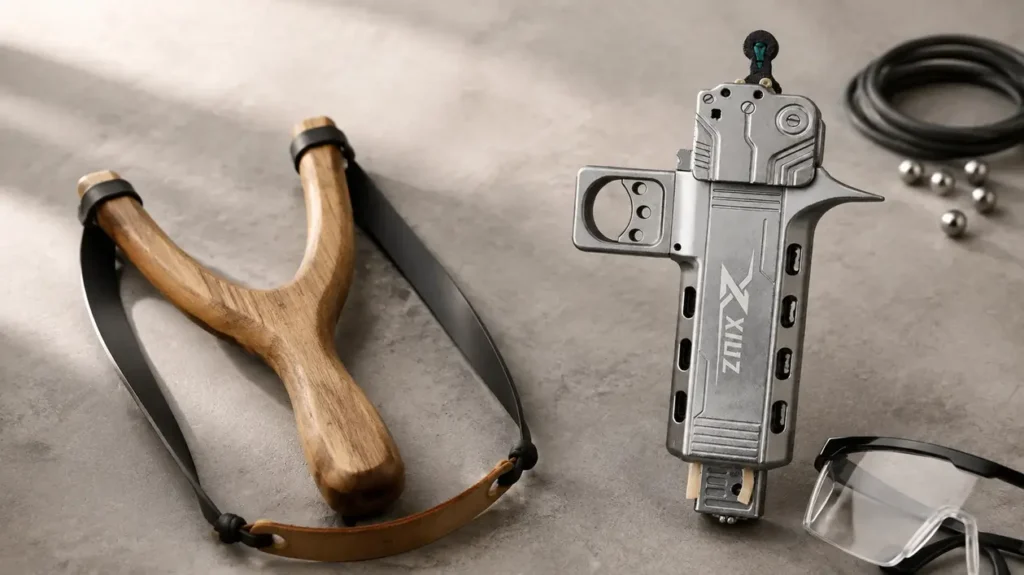
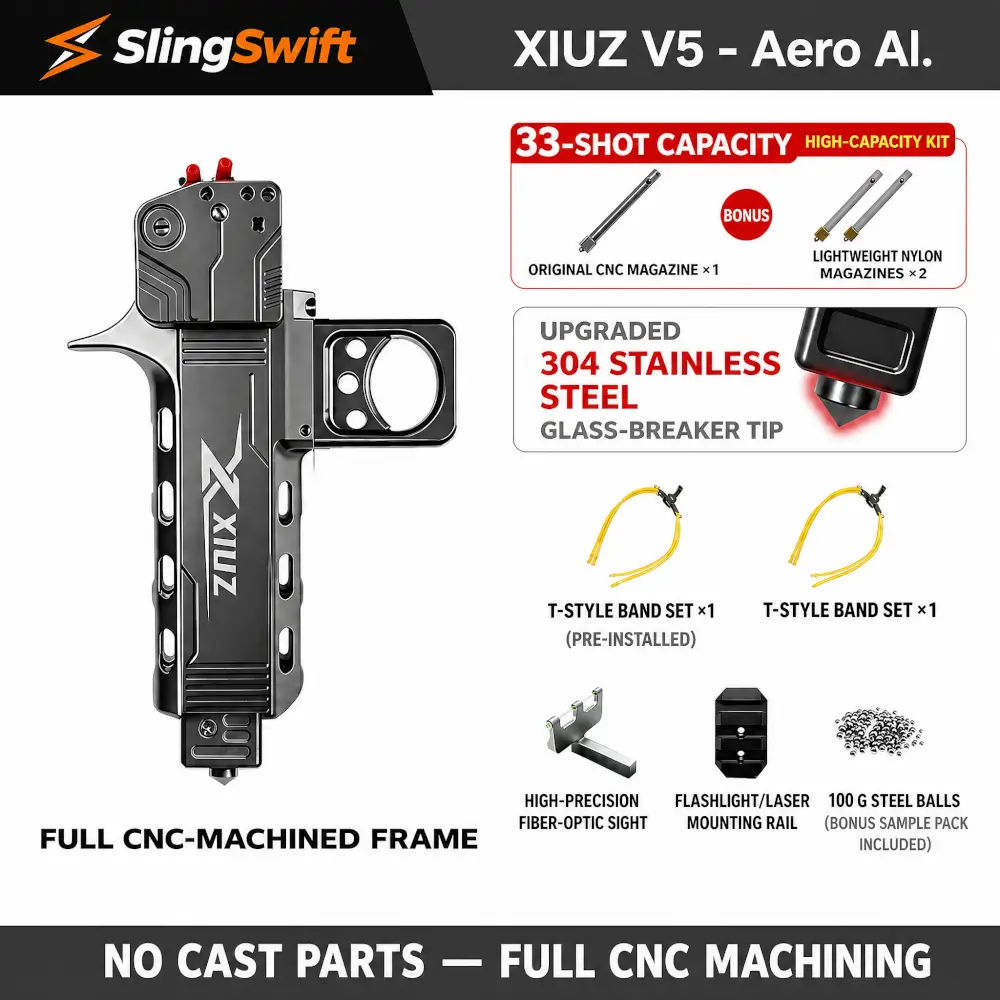
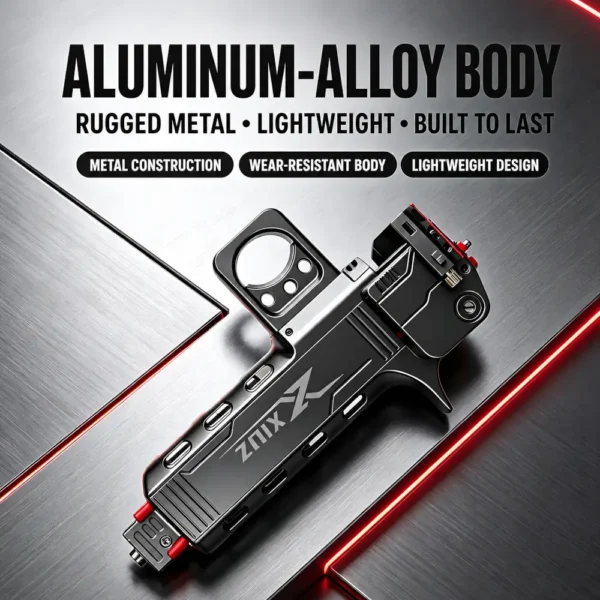
The SlingSwift XIUZ V5 – Aero Al. frame is made this second way. Our product page describes the frame as aerospace-grade aluminum billet, full CNC-machined, machined down from a 1,500 g billet to a frame of about 400 g. That is not decoration. It is metal taken away from one solid piece, not metal poured into a space.
Cast vs CNC aluminum at a glance
| What you are comparing | Cast aluminum frame | CNC-machined aluminum frame |
|---|---|---|
| How the frame is made | Molten metal poured into a mold | Aluminum cut away from a solid billet |
| What can be wrong inside | Gas porosity, shrinkage voids, seams where mold sections meet | No pour, no void; the billet’s own alloy condition is the limit |
| How wall thickness is set | Thick walls to compensate for weaker material | Metal placed where it is needed, often thinner or skeletonized |
| Typical elongation before break (published data) | Mostly 1-6% across the common cast alloys | 8-10% for 6061-T6 by section thickness |
| How it usually fails | Snaps at a void or seam under load | Bends, then cracks |
| Shape consistency from unit to unit | Varies with mold wear and process control | Held to machine tolerances, repeatable |
| Surface after finishing | Rough or as-cast texture; can be machined afterward for looks | Machined finish that shows the cutting lines |
| Price to produce | Low | Higher (machining time and wasted stock) |
| What you can verify before buying | Nothing internal from the outside | Alloy, process, and serial number |
| Best suited to | Light use where the seller is honest about the process | Long sessions, heavy bands, frames you plan to keep |
The gap that matters is the last two rows read together. Casting depends on process control that you cannot see and cannot check from a photo, and the alloy data shows what happens when that control slips: little stretch, low warning. Machining starts from a billet whose condition is known before the first cut. You are not comparing an expensive version of the same frame. You are comparing a frame that can hide a defect with one that cannot.
Why the process matters on a slingshot frame
A slingshot stores energy in elastic band sets and hands it to a projectile; the frame is the anchor for that energy (Wikipedia: Slingshot). Every time you draw and release, the frame takes a pull and a snap. Thousands of those cycles are what engineers call fatigue, defined as the initiation and propagation of cracks under repeated loading (Wikipedia: Fatigue (material)).
The same source lays out why this matters for cast parts: fatigue cracks begin at stress concentrations, and they can grow from manufacturing defects that are small enough to miss. A gas pocket or shrinkage void inside a cast wall is exactly that, a manufacturing defect sitting where the load passes through. It may not be visible. It may not fail for a year. Then it does, and because it failed on a draw, the bands are loaded when it happens.
The numbers: cast aluminum and 6061-T6 side by side
You do not have to take our word for the gap. Aluminum published data puts the two material families next to each other in one frame:
| Material | Typical elongation before break | What it tells you |
|---|---|---|
| 6061-T6 billet (XIUZ V5 – Aero Al. frame) | 8% in sections up to 6.35 mm, 10% in thicker sections | The frame stretches well before it separates |
| Common cast aluminum alloys as published in casting specifications | Mostly 1-6% across the alloys listed, with several at 1-2% | Little warning: the sample reaches its limit close to its breaking point |
Sources: 6061 aluminium alloy and the minimum tensile requirement table in Aluminium alloy, both read 2026-10-24.
Elongation is the number that matters most for a hand-held frame, because it describes how far the metal stretches before it breaks. Ductility is the umbrella term for that ability to deform; metals with low elongation crack close to their peak load, while metals with more elongation bend first. A cast part’s low ductility is also what makes its defects dangerous: a void under load barely gets to bend before the crack front reaches it. On a casting specification sheet, low elongation and internal porosity are not two separate issues. They are the same failure waiting for a draw cycle, and when it happens it happens at speed.
A cast frame does not bend out of the way, and neither do the bands
Here is the failure we want every reader to hold in their head. A frame that snaps on a draw does not quietly stop working. The band set is still stretched to full draw at that moment, and when the anchor lets go, that stored energy goes somewhere (Wikipedia: Hooke’s law).
Three things happen at once:
- The two band arms, which were pulling against the fork, snap back along their own line and into the shooter’s hand, face, and chest.
- The pouch and the ball come back toward the body instead of forward toward the target.
- The broken fork piece travels along whatever direction the break left it, at speed.
We will not put a number on that speed, because we have not measured it and different frames and bands produce different results. The point does not need a number. A steel practice ball sits in the pouch of a band set pulled back to your cheekbone. A cast frame with 1-2% elongation is a frame that gives you little warning before that ball and that hardware come back. We have seen the aftermath of a cast frame letting go on a draw more than once, and what we remember is not the broken metal on the floor.
Bystanders are in the same room as the failure
The shooter is not the only person a failure can reach. Our range days always have at least two pairs of eyes, and a bystander stands behind and to the side, in the arc a returning band or ball can follow. That is why our house rule is simple: anyone on the line wears eyewear that meets ANSI/ISEA Z87.1-2020, the US certification standard for protective eye and face wear against flying debris (Wikipedia: Eye protection). We would rather a customer skip a session than shoot a frame with a known defect, and a cast frame with a visible seam is a known defect.
Why the billet matters here
The difference the reader pays for is not that a machined frame cannot break. It is that the billet does not bring a hidden void into the load path. A CNC-machined frame is still aluminum: jump on it, pry the fork open, or leave it wet in a bag for a season and it will fail too. What it is not doing is hiding a gas pocket, a shrinkage void, or a mold seam inside the one section that carries the draw. When it does reach its limit, published elongation tells you the mode to expect: it will bend and crack visibly rather than let go clean.
That is the trade this article is asking you to make. Tens of dollars, against a frame that warns you before it sends the bands back at your face.
Why cheaper cast frames turn up inside CNC listings
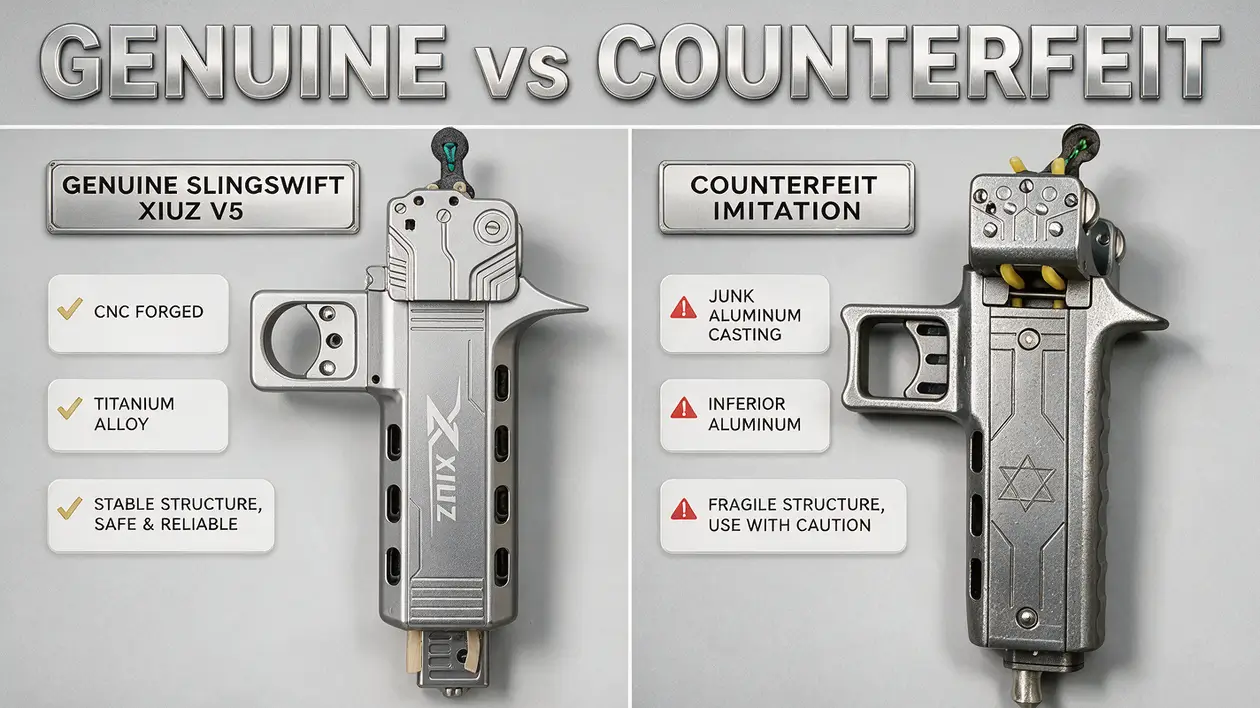
Here is a pattern we keep running into. A frame is made by casting: the outer shell is formed in a mold, then the surface is machined so the flats look sharp and the finish has the fine lines people associate with machining. The listing then calls it CNC, and the photograph, which is what a buyer actually sees, supports the claim.
What the surface treatment does is real work. It improves the finish and the fit of any machined features. What it cannot do is change the inside of the wall back into solid billet. The structure the load passes through is still a casting, with the same strength and the same failure mode as any other casting.
There is a second, harder version of the same problem: a frame that is not just similar to a well-known design but is sold under that design’s name and channel. That version costs the buyer the most, because they pay for a frame they believe is backed by a seller who will answer the phone, and the seller who actually made it has no link to that support.
We cannot and will not point at any particular store. Instead, the practical rule we give our customers is this: when a frame that looks identical to a CNC frame costs tens of dollars less, ask which process made it and who stands behind it. If the answer is vague on either count, you have your answer.
How to check a slingshot before you order
Run these five checks in order. Each one is short, and each one costs nothing unless the answer makes you stop.
- Ask what the frame is made from, and check the wording. “CNC aluminum alloy” is a process word, not a material spec. Ask which alloy the billet or casting is. 6061-T6 and similar wrought alloys are common for machined frames, and it is described in the 6061 alloy reference as a precipitation-hardened, general-purpose structural alloy with 8-10% elongation at break; cast alloys in the same reference list 1-6%. A seller who can name the alloy, the process, and where the frame is made knows their product.
- Ask whether the frame carries its own number. Each SlingSwift frame carries a serial number, one per frame, so the physical piece in your hand can be traced back to us. Ask any seller you buy from whether they can do the same. A frame that cannot be identified individually cannot be verified when it arrives or supported later.
- Confirm the serial number and model before ordering. If you are unsure which frame a listing sells, or whether a frame you are considering is one of ours, contact SlingSwift with the link and the serial number if there is one. Support can confirm the model and whether a frame is a genuine SlingSwift frame.
- Read the warranty and the returns wording. Ask for the clause, not a promise in a chat. Who replaces the frame if it fails from a defect? Who pays shipping? How long does the coverage run? If you cannot find the answer in writing, ask for it in writing.
- Check what fits the frame. A machined frame with no rail and no replacement parts is a disposable object. Check that the seller stocks bands, sights, and feeding parts for the exact model, and check whether the vendor has more than one frame so you are not buying the end of a single production run.
If you already own a frame and are not sure what it is, the receiving checklist below applies to you too, and support can help you identify what you have.
What to check when the box arrives
This is the part the product photos never show. Take ten minutes before you load anything.
- Look at the frame before you touch the bands. Hold it up to a window or a bright lamp and turn it slowly. Look for hairline cracks, especially where the fork meets the body, around any band anchor, and at the wrist. Look for seams on the outside, which is common on cast parts and can indicate the shape came from a mold.
- Look inside every opening. Feed channel, magazine window, the inside of the fork gap. Cast parts can show porosity as small pits or rough patches; machined parts show clean cutting marks.
- Check the band anchor points and the pouch mount. The anchors should be smooth and fully formed. A sharp edge, a burr, or a gap where the part should be solid is a stop signal, not a small annoyance.
- Confirm the frame’s identity. Read the serial number on your frame and match it to the order and the model. On a SlingSwift frame, one number belongs to one frame. If the number is missing, damaged, or does not match the model you ordered, contact support before you load it.
- Test fit, do not test fire. With the bands removed, check that the feeder moves, that the sight or rail mounts sit square, and that nothing binds. If something does not fit, that is a support question, not a reason to modify the frame. Never drill, file, bend, or weld a frame to make a band or a sight fit; those are the modifications that turn a sound frame into a failure waiting for the next draw.
- If something is wrong, photograph it before you use it. Most sellers, ours included, need photos to process a replacement. The returns and refunds page explains what we need and the timelines.
What SlingSwift makes, and what we stand behind
We build three auto-loading models, and all three put a full CNC-machined aluminum (or, in one case, engineering-nylon) structure in your hands rather than a cast one. Every model holds 11+1 balls in a magazine you can see through, and every shot is still yours to load, aim, and release. The auto-loading mechanism feeds the next ball; it does not fire.
| Model | Frame | Why it fits this guide | Best for |
|---|---|---|---|
| XIUZ V5 – Aero Al. | Full CNC-machined aerospace-grade aluminum billet, 1,500 g to about 400 g | Machined structural frame with a trigger-style feed | Shooters who want the most planted metal frame |
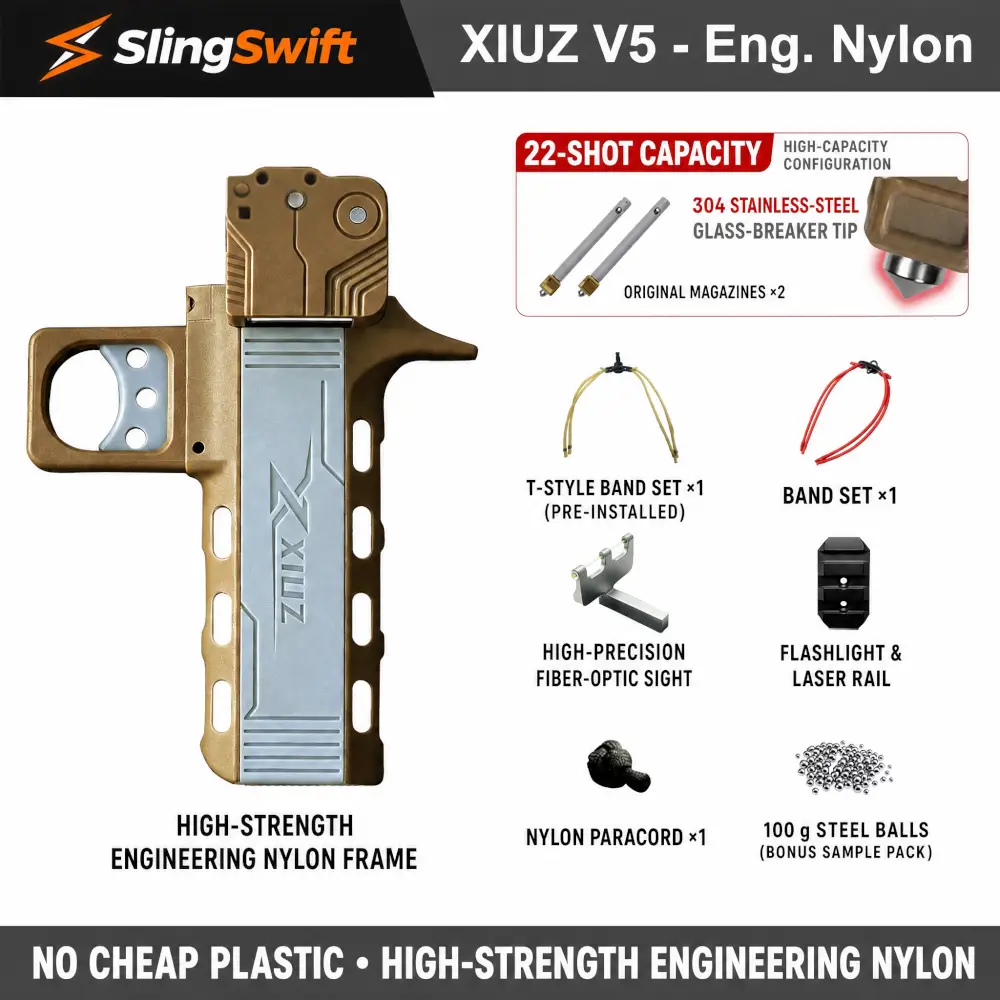
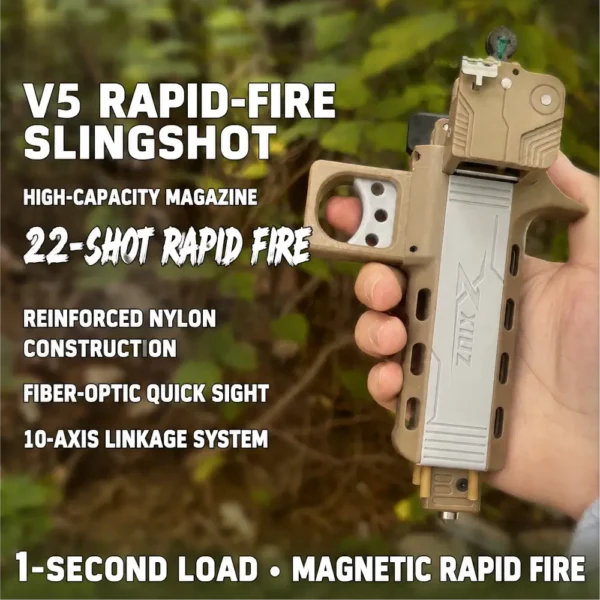
| XIUZ V5 – Eng. Nylon | Reinforced PA6 engineering nylon, listed at 224 g | Same trigger feed and magazine in a lighter build | Long aiming settles and lighter carry |
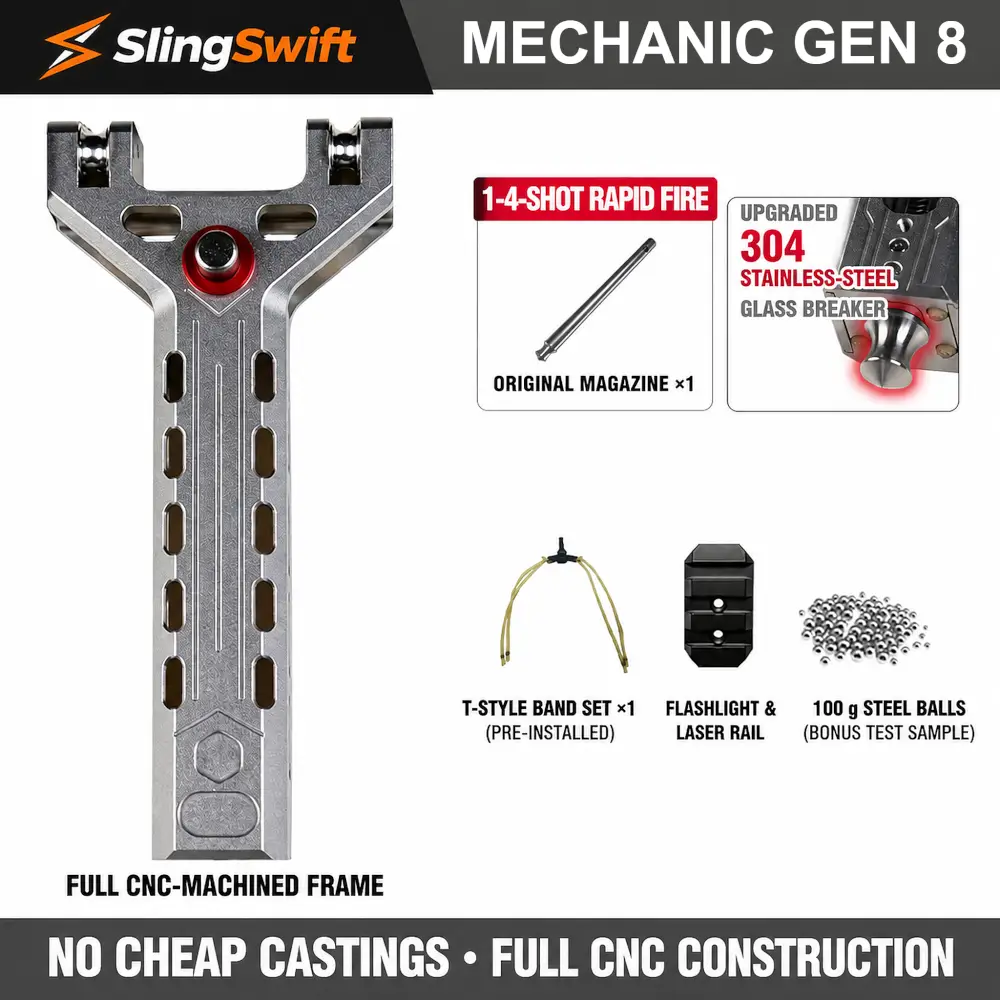
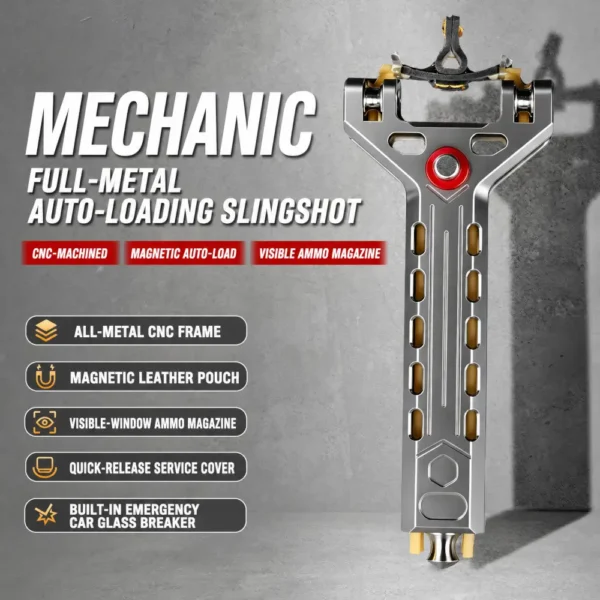
| Mechanic Gen 8 | One-piece CNC aluminum with a skeletonized grip and dual-side bearings | Machined frame with one-touch button feeding | Button-loading shooters who want a one-piece aluminum frame |
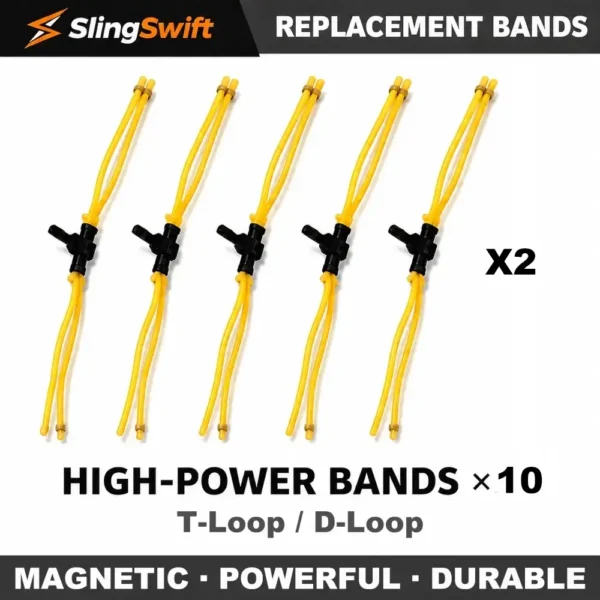
The product advantages, stated plainly. The XIUZ V5 – Aero Al. frame comes out of one billet, with an anti-jam ball path, a fiber-optic front sight, an accessory rail that accepts compatible sights, and a 304 stainless-steel front tip. It ships with one CNC ball feeder and two lightweight nylon ball feeders, two T-Style band sets (one pre-installed), the sight, the rail, the front tip, and a 100 g practice ball sample. You can see the full package on the XIUZ V5 – Aero Al. page, the XIUZ V5 – Eng. Nylon page, and the Mechanic Gen 8 page.
Genuine frames, one number each. Every SlingSwift slingshot frame that leaves our workshop carries a serial number. That number is how a frame is traced, and it is how support confirms a frame is ours. Before you order from a marketplace or a reseller, ask for the model and the source, and confirm with our support team through the contact page. Buying through the official store is the simplest way to know.
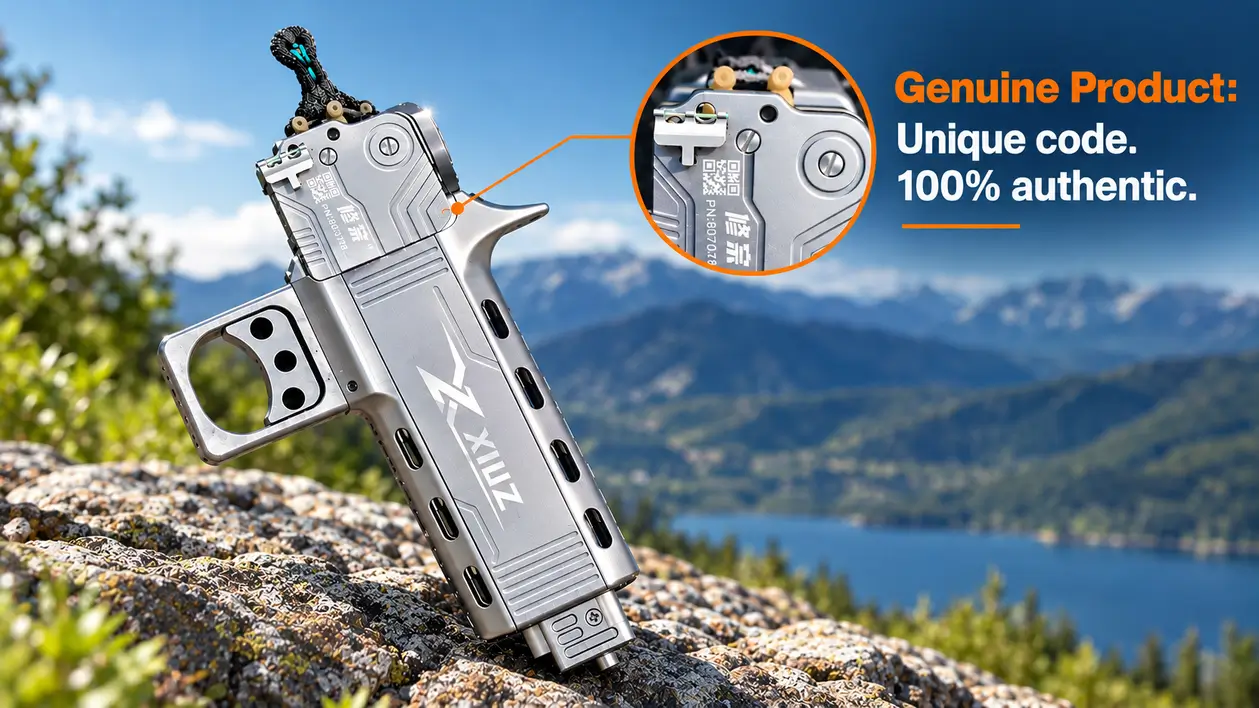
What the warranty covers. Frames that are damaged from a defect within the 1-year warranty period are replaced with a new one at no charge for the frame. Read the returns and refunds page and the shipping policy for the current process. If a frame shows a crack or a deformation, stop using it and contact support with photos before doing anything else.
What you are actually buying. The XIUZ V5 – Aero Al. frame is the most frame per dollar in this guide: one billet, a full machined structure, an anti-jam feed, a rail that takes compatible sights, a serial number, and a stated 1-year replacement. The Eng. Nylon gives you the same trigger feed and magazine in a listed 224 g build. The Mechanic Gen 8 gives you a one-piece machined frame with one-touch button feeding. Whichever you pick, the part that holds the bands is the part we are willing to trace and replace. We would rather be the workshop that sells three frames we can stand behind than a storefront with twenty we cannot.
Which frame should you buy, and which should you rule out?
If you asked us at the bench, we would not split this answer three ways. We would give you one: buy the CNC-machined frame.
- Buy CNC-machined if you shoot regularly, use anything beyond light bands, mount anything on the rail, or plan to keep the frame for years. That is most people who buy an auto-loading slingshot, because the mechanism already carries more parts and the frame is the one thing that should never be the weak link.
- Do not buy a cast frame for an auto-loading slingshot. The price difference does not survive a single failure. A cast frame that cracks on a draw costs you a frame, a band set, a range day, and possibly a trip to an eye specialist, which is many times the thirty or fifty dollars it saved.
- Do not buy from a seller who will not name the process and the alloy. This is the only hard stop in this section, and it covers every price tier. A machined frame whose seller hides what it is has the same problem as a cast one.
The money difference is real, and it is small compared with what a failure costs. Tens of dollars is the wrong place to take the cheaper option when the thing you are buying holds the bands a few feet from your face.
Our accessory plan, and what to send us
One more thing we do differently, and it comes out of the same belief. When the frame is right, the next improvement usually belongs in the accessories, not in another whole slingshot. We are currently developing a load feeder, a belt pouch, and sight upgrades, and those come from what owners tell us they want on the line. We update what is already in your hands rather than asking you to buy a whole new frame for one new feature.
If you have an idea, send it. Tell us which part you would change, what it would fix, and how you would use it. That feedback is how our accessories get better. You can browse what currently fits on the automatic slingshot accessories page.
FAQ
Is a cast aluminum slingshot strong enough?
No. A cast frame built on a controlled process can survive light use, but you cannot verify that control from the outside, and published cast-alloy data shows mostly 1-6% elongation before break against 8-10% for 6061-T6. That is a frame with little warning when it reaches its limit. A CNC-machined frame from a billet removes that unknown, and it is the frame we recommend for any regular shooting.
How can I tell cast from CNC just by looking?
Often you cannot, and that is the point. A cast frame that has been machined on its outer surfaces can look like a CNC frame in a photograph. Closer up, look for mold seams, porous or pitted patches inside openings, and thickness that stays the same everywhere. Machined frames show cutting marks and often thinner, skeletonized sections.
Do I need eye protection with a CNC frame?
Yes. A machined frame is a better bet than a cast one, not a guarantee against a ball bouncing back or a band failing. Wear eyewear certified to ANSI/ISEA Z87.1-2020 every session, and treat any crack or deformation in the frame as a reason to stop shooting.
What is the slingshot serial number for?
Each SlingSwift frame carries a serial number, one per frame, so the physical slingshot can be traced and verified. If you are buying from a reseller or a marketplace and you are unsure whether the frame is genuine, contact SlingSwift support with the listing and the number, and we will confirm it.
What does the warranty actually cover?
Within the 1-year warranty period, a frame damaged by a defect is replaced with a new one. The customer pays the return shipping of the original frame, because of the cost of getting a metal frame back to us. Contact support with photos first; the current process is on the returns and refunds page. A framed replacement is still worth far more than the discount on a cast frame that fails.
When should I stop using a frame?
At the first visible sign: a crack at the fork, the wrist, or a band anchor, a deformation that was not there before, or a band anchor that has worn or sharpened. Do not try to repair or reinforce it, and do not keep shooting to see if it holds. Contact the seller or us with photos.
The bottom line
The frame is the part that holds stretched bands under load next to you, and that is worth paying for properly. Ask which process made the frame, ask for the frame’s own number, ask for the warranty in writing, and inspect the frame when the box arrives. Do not save tens of dollars on the one part that can send loaded bands back at your face. If you want a machined frame, a visible magazine, and a serial number behind it, compare the three SlingSwift models and pick the one that matches your frame preference and weight. If you are not sure which model or what fits, ask support before you order.